

Check out this detailed guide on how you can improve your agility and speed with targeted exercises!
Advertisements
Have you ever wondered why some athletes look like they can fly?
And others have trouble keeping up?
The answer may lie in specific exercises for agility and speed.

THE functional training is very effective.
Advertisements
It uses natural body movements to improve agility and speed.
It can be done at home or outdoors, without the need for special equipment.
You benefits of agility there are many.
Advertisements
It improves coordination and body awareness.
It also helps conserve energy and reduce impact on joints.
To become more agile and faster, it is important to do isometric exercises, dynamic stretching and strength training. explosive force.
++ Mental Training in Sports: What is it and why is it important?
Main highlights
- Functional training uses natural body movements.
- Benefits include improved coordination and development of body awareness.
- Exercises such as isometrics and dynamic stretching are essential.
- Activities can be carried out at home or outdoors, without the need for specialized equipment.
- Exercise helps save energy and reduce the impact on joints.
The importance of agility and speed in physical performance
Agility and speed are essential for any athlete. They allow for quick changes of direction. This is crucial in many sports.
In addition to improving athletic performance, agility helps prevent injuries. It also improves stability and balance.
THE functional training is essential for physical health.
It improves the cardiorespiratory capacity and the general condition.
Specific exercises increase muscular endurance and flexibility.
Exercises such as speed ladders and box jumps are very effective.
They work multiple muscles, burning calories and increasing your heart rate.
| Exercise | Benefits |
|---|---|
| Speed Ladder | Improves reflexes, concentration and coordination. |
| Box Jumps | Increases the explosive force and balance. |
| Tuck Jumps | Strengthens leg muscles and cardiovascular endurance. |
| Squat Jumps | Improves the cardiorespiratory capacity and burning calories. |
Technology has also advanced significantly in sports, helping us apply knowledge more effectively.
Academia Pratique Fitness, for example, has more than 90 units in Minas Gerais and Santa Catarina.
They focus on training that improves athletic performance.
Invest in functional training and agility is essential.
This improves the cardiorespiratory capacity and increases performance in any sport or physical activity.
Functional exercises to improve agility
You functional exercises are very effective in increasing agility.
They are perfect for everyone, from beginners to already athletes.
These exercises work multiple muscles and joints at the same time.
This makes the workout more complete than traditional exercises.

Add a exercise circuit varied is very good.
Movements like quad stretch, hip opener, hamstring scoop, walking lunge and deep squat are part of a dynamic training. They improve both agility and explosive force.
Below is a table with some recommended functional exercises to improve agility:
| Exercise | Benefits |
|---|---|
| Quad Stretch | Improves the flexibility and hip mobility. |
| Hip Opener | Releases tension in the hip, improving motor coordination. |
| Hamstring Scoop | Dynamic stretching to improve flexibility. |
| Walking Lunge | Strengthens legs and hips, promoting balance and coordination. |
| Deep Squat | Works glutes and quadriceps, increasing strength and agility. |
| Bulgarian Split Squat | Focuses on balance and unilateral strength. |
| Single Leg Hop | Improves stability and coordination. |
| Box Jump | Explosive exercise that increases power and agility. |
For best results, do a dynamic training of functional exercises 2 to 3 times a week.
This improves agility and motor coordination.
It also helps prevent injuries when done with strength training and rest days.
Regularly practicing these exercises increases strength, flexibility and body resistance.
To make the correct and safe movements, it is good to have the help of a professional.
Instructors at the Cia Athletica gym, for example, help adjust movements during workouts.
++ Learn the importance of sports for children
Best exercises to increase speed
To increase speed, it is important to focus on exercises that strengthen strength and agility.
One study showed that plyometric movements, such as medicine ball jumps, improve leg strength.
This also improves 1 rep max squats.
Training Olympic lifts like the Clean and Snatch is effective for achieving high speeds.
These exercises of power training are essential for anyone who wants to be faster.
Doing strength exercises like squats and lunges helps you develop the strength you need to accelerate quickly.
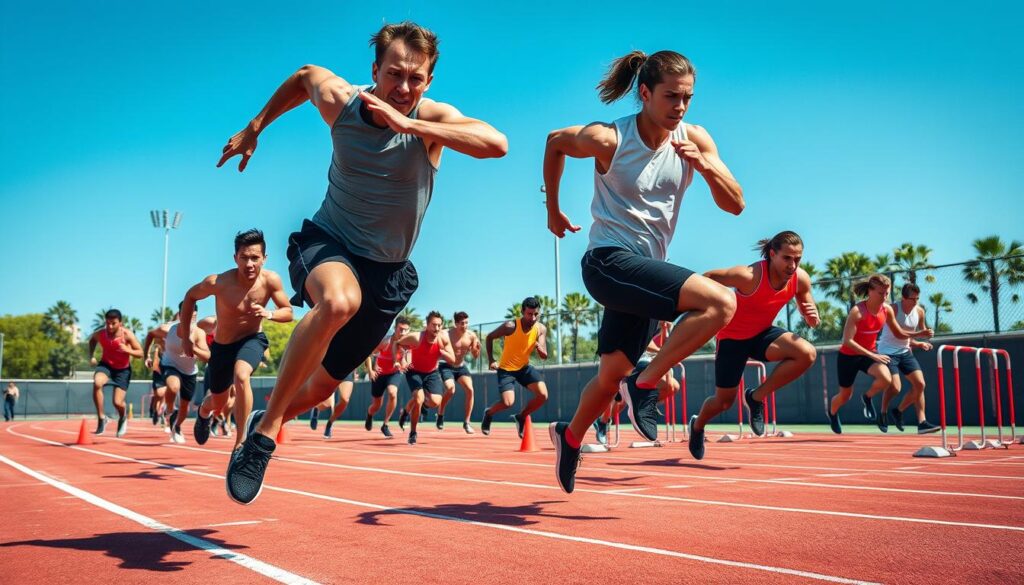
Functional ladder exercises are great for turning strength into agility.
Using the Prowler Sled, lifting tires, and kettlebell swings are best practices.
They improve the agility in sport and speed.
Fast runners have less contact with the ground and pass more times.
They benefit from sprints on steep hills.
Working on muscle elasticity, strength and range of motion is crucial for running speed.
Endurance exercises, such as resistance running and alternating leg runs, also increase speed.
A holistic training program is essential.
Combine strength, power, and endurance training with running techniques and cardiovascular exercises.
This will improve your overall racing performance.
How to improve your agility and speed with targeted exercises
To improve agility and speed, you need to focus on specific exercises.
This can include balance, strength, and dynamic movements.
It is important to vary activities to obtain better results.

You speed movements are essential, especially in football.
Fast and agile players are more likely to be decisive.
Speed and agility training can be done in a variety of places, such as fields, streets, homes, or gyms.
A good workout plan starts with exercises every three days.
Then increase the frequency to improve even more.
Exercises like jumping jacks are great for strengthening your legs, essential for athletes.
To improve leg explosiveness, squat jumps are very effective.
Concentration squats help with stability, which is important on soft surfaces.
Sprint training is essential to increase power, pace and explosiveness.
It's ideal to practice in an open field. Using weighted vests or agility ladders can further aid training.
| Statistical Data | Description |
|---|---|
| Year 2000 | Taekwondo is included in the Olympic Games, alongside judo. |
| 250+ employees | At Academia Pratique Fitness they became Partners. |
| 2023 | Academia Pratique Fitness closed with more than 90 units in MG and SC. |
| 2024 | Expansion plan to open 40 new units in PR, ES and GO. |
Improve your agility and speed: Plyometrics
Plyometrics are essential to increase explosive force in athletes.
This applies to sports such as volleyball, basketball, swimming, tennis and athletics.
This technique uses quick, intense exercises to improve physical performance.

From 1993 to 2007, studies showed that plyometrics improve explosive muscular strength.
Athletes of all genders and ages benefit.
Exercises like jump squats and depth jumps are crucial.
For best results, it's important to take longer rest intervals. This helps maintain movement quality.
A 10-week study of 30 training sessions showed a large increase in explosive strength.
Volleyball players improved their lower limb strength.
Plyometric maneuvers help prevent loss of muscle strength during fast movements.
“Fleck and Kraemer (1999) found that training utilizing the stretch-shortening cycle leads to an increase in strength by recruiting more motor units or increasing the discharge rate of recruited motor units.”
| Sport | Observed Improvement | Duration of Study |
|---|---|---|
| Volleyball | Explosive Strength in Lower Limbs | 10 Weeks |
| Basketball | Vertical Jump Capacity | 14 Weeks |
| Athletics | Increase in Muscle Power | 6 Months |
To improve your explosive strength, add plyometric exercises to your training. Plyometrics have been used since the 1960s.
It is effective all over the world, from young athletes to special military personnel.
+ Functional training: benefits and how to integrate it into your routine
Improve your agility and speed: Functional training on the ladder
One agility ladder is great for improving coordination and do fast movementsIt helps develop agility, speed, and balance. It's perfect for soccer, volleyball, and runners.
There are three types of agility ladders: standard, adjustable distance, and adjustable height. It's important to choose the one that best suits your needs.
| Product/Brand | Price | Features |
|---|---|---|
| Agility Ladder YANGFIT | R$ 59.90 (or 2x R$ 29.95 interest-free, or R$ 58.10 via Pix) | 8 adjustable steps, made of Nylon and PVC, 5 meters |
The YANGFIT ladder is easy to assemble and disassemble. It's made of nylon and PVC. It helps improve reflexes, agility, and strength.
To train well, warm up and use the stairs. This improves your performance and motor skills.
Improve your agility and speed: Balance exercises for greater agility
Doing balance exercises is crucial to improving your agility.
Practices such as single-leg stands and burpees strengthen muscles.
This helps to control the body better and react quickly in sports.
Specific techniques are essential to obtain good results.
Walking in a straight line for 20 steps improves dynamic balance.
Raising your arm for 10 seconds also increases physical coordination.
“Regularly practicing balance exercises can also prevent falls, a common problem among older adults.”
For a more challenging experience, use weights, balls, bosu balls, and resistance bands.
Staying in balance for 30 seconds, 5 to 10 times, improves muscle control.
Training balance by jumping over objects or jumping rope increases agility.
Exercises like squat jumps and lateral lunges also improve hip stability.
This is crucial for sports that require fast movements.
Practicing balance on a Pilates ball or walking on a slackline is great.
These exercises challenge and improve balance, increasing agility.
| Exercises | Benefits |
|---|---|
| Walk in a straight line | Improves dynamic balance |
| Raise your arm for 10 seconds | Improves physical coordination |
| Jump rope | Increases agility |
| Walking on the slackline | Challenges and improves balance |
Practicing balance improves agility and physical performance.
It also helps prevent injuries, keeping the body ready for sporting challenges.
Distribute weight evenly to prevent injury
Distributing your weight evenly is essential to avoid injuries, especially in activities that require agility.
Keep the correct posture protects joints and prevents muscle imbalances.
This greatly reduces the risk of injury.
The feet of African elephants are a perfect example.
They are adapted to distribute forces evenly.
Despite weighing between 4,700 and 6,048 kg, they show the effectiveness of a good weight distribution.
Reptiles like turtles also use this strategy.
Their hooves are made to disperse force and prevent injury.
This idea could inspire the creation of protective materials and sports equipment.
“By adopting these strategies in your sports practice, you not only improve your performance, but also ensure an effective barrier against injuries.”
THE functional training emphasizes the correct posture and the weight distribution.
Equipment such as kettlebells, balance discs and mini bands are used.
They help to work strength and flexibility, protecting against impacts and imbalances.
| Equipment | Benefits |
|---|---|
| Kettlebell | Works strength, endurance and flexibility |
| Balance disc | Improves stability and strengthens the core |
| Mini band | Develops the core, arms and legs |
Training circuits for agility and speed
Training circuits are great for improving agility and speed.
They involve dynamic exercises in quick sequences. This works multiple muscle groups and keeps your heart racing.
Circuit routines use tools such as agility ladders, cones and reaction balls.
These items are crucial for improving coordination and accuracy.
Jumping platforms and trampolines are recommended to increase leg power.
This is essential for agility. For a more intense workout, add resistance bands to your exercises.
They help develop muscular strength and endurance.
Adding accessories like balance discs, mini hurdles, and marking tape makes your workouts more varied.
They are also more challenging and interesting.
| Equipment | Benefits |
|---|---|
| Agility Ladder | Improves speed of change of direction, coordination and precision of footwork. |
| Cones | They improve lateral agility and the ability to make quick changes of direction. |
| Reaction Balls | They promote improved muscular and neural performance. |
| Jumping Platforms and Trampolines | They develop power in the legs. |
| Resistance Bands | They intensify training by promoting strength and muscular endurance. |
Pro Sport RS has been offering training equipment since 2007.
It helps athletes push their limits. Interval training improves agility, speed, and accuracy.
Agility involves control, precision and core strength.
These qualities are essential and can be improved with the right exercises.
++ What are the benefits of regular physical exercise?
Proper nutrition for better performance
To have optimal physical performance, it is essential to have a diet for athletes balanced.
She must be rich in essential nutrients and adapted to the sport. This improves your health and performance and helps with recovery after training.
One diet for athletes Ideally, half of the plate should be fruit and salad.
It's a good idea to replace 50% of your grains with whole grains. It's also recommended to replace whole milk with skim or semi-skim milk.
Consuming plenty of lean proteins is very important.
This helps in health and performanceDrinking water instead of sugary drinks also helps control weight and stay hydrated during exercise.
| Aspect | Recommendation | Benefit |
|---|---|---|
| Fruits and Salad | 50% of the dish | Increased intake of vitamins and minerals |
| Whole Grains | 50% of grains | Better digestion, sustained energy |
| Skim Milk | Replace whole milk | Less fat, more essential nutrients |
| Lean Proteins | Variety and frequency | Muscle maintenance and building |
| Water | Replace sugary drinks | Hydration, fewer calories |
Carbohydrates are essential to support the energy demands of sport.
Consuming 30 to 60g of carbohydrates per hour during long activities helps maintain energy.
This also helps delay muscle fatigue.
Protein consumption is also crucial. 1.2 to 1.6g of protein per kg of body weight per day stimulates muscle synthesis.
Nutritional supplements can help your diet by improving your muscle recovery, depending on the sport and training phase.
Improving Your Agility and Speed: The Role of Rest and Recovery
After intense workouts, it's crucial to pay attention to rest.
The body needs to recover, repair minor injuries, and recharge. Without rest, muscles don't recover well, compromising their performance.
Sleeping 7 to 10 hours a night is essential, especially for young athletes.
Sleep helps repair muscles and increases energy for new workouts.
It also improves memory and motor learning, which are important for improving skills.
Experts suggest a gap of 48 to 72 hours between workouts.
Using this time for stretching or walking is good.
This maintains circulation without overworking your muscles. This allows you to balance training and rest, improving results and preventing injuries.