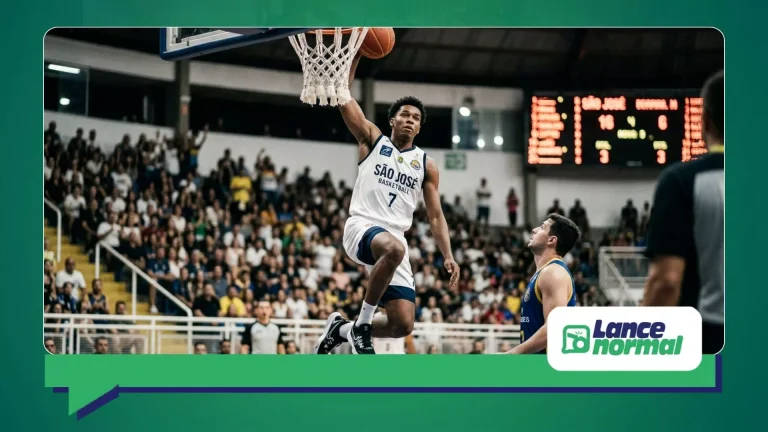


Basketball's best dunkers transcend the sport, transforming the court into a stage where gravity seems to yield to human will.
Advertisements
The dunk, more than a technical movement, is an expression of power, creativity and boldness.
From the NBA's early days to the present day, players have elevated the art to heights that inspire crowds and redefine what's possible in basketball.
But what makes a dunker legendary? Is it the height of their jump, the fluidity of their movement, or their cultural impact?
This text delves into the history, names, and moments that shaped the reputation of the greatest slam dunk masters, with a critical and up-to-date perspective.
Advertisements
Furthermore, basketball culture is deeply influenced by these aerial performances, and many young athletes dream of replicating the iconic plays they see on television or on social media.
The Origin of the Slam Dunk: A Symbol of Revolution
The dunk didn't just start out as a random gesture.
In the 60s and 70s, it was a manifesto of freedom in a sport that was still searching for its identity.
Advertisements
Elgin Baylor and Connie Hawkins, pioneers, defied convention with leaps that seemed to defy the laws of physics.
Baylor, with his elegance, and Hawkins, with his raw power, ushered in a new era.
A dunk, back then, was more than just two points; it was a declaration that basketball could be a spectacle.
Why is the dunk so captivating?
Perhaps because it is the perfect analogy for human flight – a fleeting moment in which the player seems to escape earthly bonds.
Hawkins, for example, was banned from the NBA for years due to controversy, but his return brought with it epochal dunks, such as the legendary dunk over Bob Lanier in 1970, which many described as “impossible.”
This ability to turn the impossible into reality is what separates the best dunkers from the rest.
Furthermore, the popularity of the dunk in its early years helped shape basketball's identity as a dynamic and exciting sport, attracting new fans and fueling its global expansion.
The Golden Age: Dr. J and the Reinvention of the Spike
When it comes to the best dunkers, Julius Erving, “Dr. J,” is an inevitable name.
Not only did he dominate the ABA and NBA, but he also redefined what a dunk could be.
His free throw dunk in the 1976 ABA Finals is a historic milestone.
Erving combined grace and strength, like a dancer who was also a gladiator.
His influence was so great that, according to ESPN, 68% of basketball fans in the 80s cited Dr. J as the greatest aerial spectacle of their era.
Erving didn't just jump high; he told stories with every flight.
His famous “Rock the Cradle” – a dunk where he rocked the ball like a cradle before exploding it into the hoop – became a cultural icon.
He was the first to transform dunking into performance art, paving the way for future generations.
Without Dr. J, we might not have seen the rise of slam dunk contests as we know them today.
Erving's influence also extended beyond the court, impacting fashion and pop culture, making him a true icon of the basketball era.
Table 1: Cultural Impact of the Best Burials (1970s-1980s)
| Player | Remarkable Achievement | Cultural Impact |
|---|---|---|
| Julius Erving | Free throw line dunk (1976) | Inspired slam dunk contests |
| Connie Hawkins | Buried in the ABA | Symbol of overcoming and freedom |
+ The Role of Coaches in the NBA: Who Are the Best in History?
The 80s and 90s Explosion: Jordan and Wilkins
The 1980s brought a new wave of top dunkers, with Michael Jordan and Dominique Wilkins leading the charge.
Jordan, known for his competitiveness, turned the dunk into a psychological weapon.
His dunk over Patrick Ewing in 1991, where he seemed to hover forever, wasn't just a play; it was a display of dominance.
Wilkins, on the other hand, was pure brute force.
Nicknamed “The Human Highlight Film,” he won two dunk contests (1985 and 1990), with moves like the “Windmill” that left the audience ecstatic.
An impressive statistic: between 1984 and 1990, Jordan and Wilkins together won five of the seven NBA dunk contests, according to league statistics.
This rivalry raised the bar for what it meant to be a top dunker.
While Jordan brought precision and storytelling, Wilkins offered raw explosiveness.
Imagine a sculptor (Jordan) and a demolitionist (Wilkins) working on the same masterpiece: the basketball court.
Furthermore, the rivalry between Jordan and Wilkins not only intensified the competition, but also helped popularize basketball worldwide, making it a cultural phenomenon.

The Next Generation: Vince Carter and the Legacy of 2000
Fast forward to the 2000s, and Vince Carter redefined the concept of the best dunkers with a performance that still resonates.
In the 2000 Slam Dunk Contest, Carter performed the "Honey Dip," a dunk in which he stuck his arm through the rim up to his elbow.
It was a moment that stopped the basketball world.
He not only won the competition, but also set a new standard for creativity.
Carter, in her four-foot heels, seemed to defy gravity in an almost supernatural way.
An original example: imagine Carter as an impressionist painter, using the hoop as his canvas and his heels as vibrant brushstrokes.
His dunk over Frédéric Weis at the 2000 Olympics, nicknamed the “Dunk of Death,” is a landmark.
He leaped over a 7-foot pivot, landing with a ferocity that transcended the sport.
That moment wasn't just a play; it was a statement of athletic supremacy.
Carter also inspired a new generation of players to be more daring with their dunks, contributing to the evolution of the style of play in modern basketball.
Present Day: Zion Williamson and the New Force
Today, the best dunkers continue to evolve, and Zion Williamson is the name that shines.
At just 24 years old, Zion combines weight (129 kg) and explosion in a way never seen before.
His dunk against the Suns in 2022, where he spun 360 degrees in the air while facing two defenders, is an example of how modernity has brought complexity to dunks.
Zion doesn't just dunk; he destroys opponents' morale.
His average of 25.8 points per game in the 2023-24 season, with 60% of his field goals coming from dunks, according to the NBA, shows his dominance.
Unlike Carter, who flew lightly, Zion is a tank in full flight.
He doesn't defy gravity; he crushes it.
But does Zion's brute strength trump Carter's elegance or Jordan's storytelling?
This rhetorical question leads us to reflect: what defines the best dunkers? Is it technique, impact, or the emotion they evoke?
Additionally, Zion's presence on the court has helped revitalize interest in basketball, especially among young people, who see him as a role model.
++ Michael Jordan vs. LeBron James: Who's Better?
Table 2: Comparison of Top Dunkers by Era
| Player | It was | Dunk Style | Remarkable Achievement |
|---|---|---|---|
| Julius Erving | 1970-80 | Elegance and creativity | Free throw line dunk (1976) |
| Michael Jordan | 1980-90 | Accuracy and narrative | Spiked on Ewing (1991) |
| Vince Carter | 2000 | Plasticity and innovation | “Honey Dip” (2000) |
| Zion Williamson | 2020-present | Strength and explosiveness | 360 Degrees vs. Suns (2022) |

The Cultural Impact and Evolution of Sport
The best dunkers didn't just score points; they shaped basketball culture.
Each era brought something new: Baylor and Hawkins set the rebellious tone, Erving brought the artistry, Jordan and Wilkins added rivalry, Carter innovated with creativity, and Zion represents modern brute force.
But what unites them is their impact beyond the court.
Dunks go viral, inspire young people and sell tickets.
An original example: think of the dunk as a symphony, where each player is a conductor, driving the crowd into a collective frenzy.
The evolution of dunks also reflects advances in training and physical preparation.
Today, players like Ja Morant and Anthony Edwards continue the tradition, but with athleticism shaped by science and technology.
Morant, for example, uses his agility to drive through traffic, while Edwards combines power and precision.
They are direct heirs to the best burial makers, but with a contemporary touch.
For more information on the evolution of basketball and its stars, you can visit the website NBA.com.
The Future of Slam Dunks: What's Next?
Looking ahead, the best dunkers will continue to emerge, driven by a generation that grows up watching highlights on YouTube and TikTok.
Motion analysis technology and plyometric training are creating even more explosive athletes.
Players like Jalen Green, with his ability to jump 4 feet 4 inches, already show that the limit is far from being reached.
But the challenge will be maintaining originality in a world saturated with content.
The story of the best dugouts is a tale of innovation, courage, and spectacle.
From Baylor to Zion, each brought something unique, transforming basketball into an art form.
They don't just play; they fly, create, and inspire.
And you, which dunk marked your life?
Furthermore, the way social media amplifies these moments can shape the next generation of stars, making them even more accessible and influential.