


The relationship between human performance and competition reveals in athletics a direct synthesis of essential physical capabilities, showing how strength, speed, and endurance shape contests based on fundamental motor skills without artificial layers or complex external interventions.
Advertisements
Within this universe, athletics expresses movements that have accompanied humanity since its origin, maintaining a close connection with natural actions such as running, jumping, and throwing—elements that reflect intrinsic and easily recognizable skills in any culture.
The structural simplicity of the events allows results to be determined by the body's efficiency and technical precision, making the sport a field where individual merit is clearly and objectively presented to the public.
The universality of the rules facilitates global comparisons, creating an environment in which athletes from all parts of the world compete under similar conditions and face similar challenges to achieve peak performance.
The absence of complex equipment makes athletics an accessible practice, allowing any individual to experience its various disciplines and immediately understand the essence of the physical effort involved in competitions.
Advertisements
This combination of naturalness, universality, and clarity transforms athletics into a benchmark of sporting purity, highlighting it as the starting point and structural foundation of various modern sporting practices.
The historical origin and formation of the essence of athletics.
Athletics originated as a direct representation of essential human capabilities, carrying symbolism that has spanned different civilizations since the earliest competitive records of classical antiquity.
Competitions held in ancient Greece already valued strength, speed, and precision, demonstrating how simple movements were sufficient to measure physical excellence and competitive spirit among participants.
Advertisements
Events based on movement, jumping, and throwing have been maintained throughout the centuries due to the universality of their motor skills, ensuring that anyone could quickly understand their competitive logic.
The development of modern athletics has preserved this structural simplicity, converting primitive actions into organized modalities that prioritize clarity and objectivity in results.
With the emergence of sports federations, competitions began to follow uniform regulations, ensuring that competitors from different continents competed under equivalent conditions.
Historical documents cataloged by Smithsonian Institution They demonstrate the continuity of the sport over centuries, reinforcing its role as the foundation of human competition.
++ What sports teach about discipline and mindset.
Performance objectivity as a trademark
Athletics stands out for its objectively measurable results, eliminating subjective interpretations that could influence performance evaluation and the determination of winners.
Timed events measure speed with millimeter precision, making time a universal benchmark for comparing athletes from different eras, countries, and competitive conditions.
Jumps and throws feature precise measurements, allowing small differences to determine positions and establish new records without room for interpretive dispute.
Clarity in defining performance promotes transparency and makes each achievement understandable, even for viewers with little technical knowledge of the sport.
Objectivity also facilitates scientific analysis of movement, contributing to studies on biomechanics, physiology, and high-performance training applied to athletics.
Research published by National Library of Medicine They explore how precise measurements help in understanding physiological limits in athletic events.
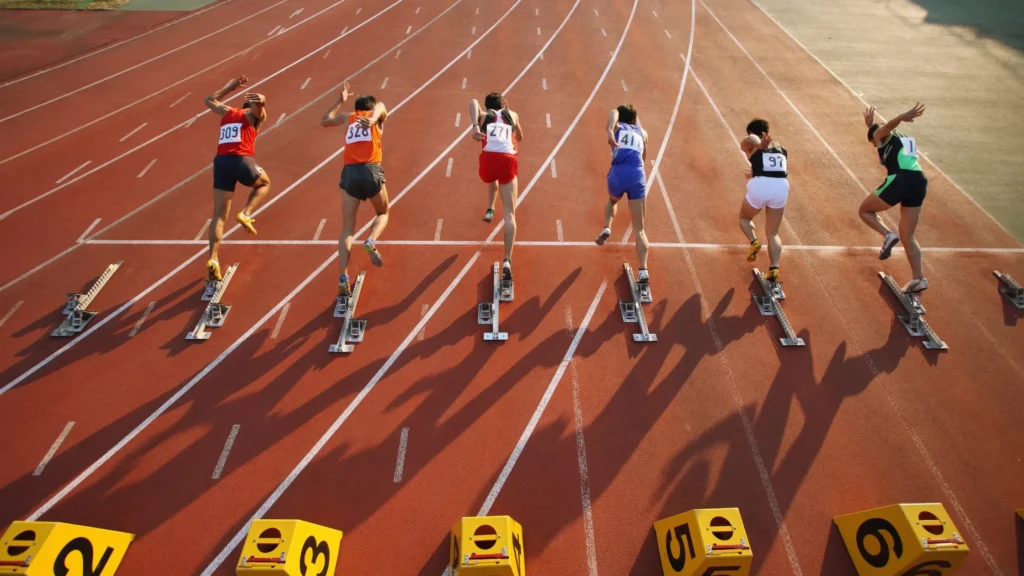
Universality and accessibility as fundamental pillars.
Athletics is accessible because it requires little equipment, allowing children, young people, and adults to start practicing in schools, parks, and public spaces without significant investment.
This simplicity democratizes the sport, expanding the diversity of athletes and strengthening development in countries with limited infrastructure for high-cost sports.
The universality of the rules promotes global competitions that maintain the same format regardless of the continent, reinforcing a shared sporting identity between different cultures.
The ease of understanding the events allows spectators to follow the competitions naturally, quickly identifying who is leading, who jumps the farthest, or who throws with the greatest efficiency.
This instinctive understanding of competition strengthens the emotional connection between the public and the athletes, turning major athletics events into symbolic moments of unity and celebration.
The structural lightness of the sport also facilitates the implementation of school programs that enhance children's physical development and encourage lifelong sporting habits.
++ The 10 Greatest Emotions in Olympic Athletics
The relationship between body, technique, and human achievement.
Performance in athletics depends on a balance between physical conditioning, refined technique, and the emotional management necessary to withstand competitive pressure in high-performance environments.
Rigorous training improves motor patterns, transforming simple movements into highly efficient actions that use energy strategically to maximize results.
The technical demands of the events create a continuous path of evolution, showing that athletes overcome physiological limits by refining posture, rhythm, coordination, and body alignment.
The combination of movement science and adaptability transforms the athlete into the protagonist of challenges that test strength, speed, and endurance in a balanced way.
Individual achievement manifests itself when athletes break records and expand the boundaries of what is possible, inspiring new generations to pursue excellence and athletic resilience.
These characteristics reinforce the essence of athletics as a pure expression of the human pursuit of physical, technical, and mental evolution.
++ The race among major brands for broadcasting rights.
The symbolism of athletics in the global sports scene.
Athletics occupies a central position in international competitions, serving as a structuring reference for sports programs, ceremonies, and traditions that celebrate unity among peoples.
Global sporting events utilize athletic competitions to open and close celebrations, demonstrating how deeply this modality is connected to the collective identity of sport.
World records become universal symbols of greatness, representing individual achievements that elevate sporting history and inspire millions of spectators around the world.
The symbolic dimension also manifests itself when athletes overcome social, historical, or territorial barriers, demonstrating that effort and talent can transcend limits imposed by context.
The emotional impact of the events reinforces how athletics translates essential values such as discipline, courage, respect, and competitive spirit in front of international audiences.
Studies organized by British Museum They investigate how sporting traditions reflect cultural identities and symbolism shared by different civilizations.
Table — Characteristics that make athletics the purest sport
| Feature | Description |
|---|---|
| Structural simplicity | Tests based on essential motor gestures |
| Objectivity of results | Clear measurements of time and distance. |
| Universality | Equal rules worldwide |
| Accessibility | Minimal equipment required |
| Cultural symbolism | Historical representation of human competition |
Conclusion
Athletics has established itself as a pure expression of human competition because it maintains a direct link with essential physical capabilities that have accompanied humanity since ancient times.
Its structural simplicity reinforces clarity and impartiality, allowing performance to be evaluated by objective parameters that are universally understood by viewers of any culture.
Universality and accessibility make the sport inclusive, strengthening collective participation and expanding the social, cultural, and educational impact of athletics around the world.
Combining history, science, and technical evolution, athletics remains a fundamental reference point for understanding the essence of human competition and its continuous pursuit of self-improvement.
FAQ
1. Why is athletics considered so universal?
Because it utilizes fundamental motor gestures present in all cultures and requires a minimum structure for practice.
2. How does athletics measure performance with such precision?
It uses stopwatches, sensors, and standardized measurements that eliminate subjective interpretations during competitions.
3. Does athletics influence other sports?
Yes, running, jumping, and strength techniques are used as a foundation for training in various competitive sports.
4. Why is this sport so symbolic internationally?
Because it represents unity, overcoming challenges, and a sporting tradition shared by different peoples since antiquity.
5. What makes athletics attractive to new participants?
The simplicity of the tests and ease of access encourage a quick start, hands-on learning, and constant improvement.