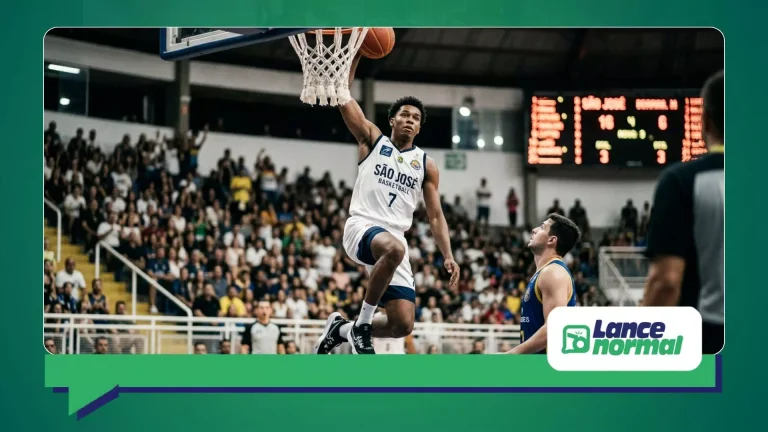

THE three-point shot is a skill in basketball modern. Mastering this technique requires constant training and attention to detail. In basketball Nowadays, efficiency in long-range shooting can be the key to a team's success.
Advertisements
To improve the three-point shot, it's essential to focus on technical, physical, and mental aspects. Correct body posture, proper hip and knee flexion, and the application of force into the ground are essential to increasing the power and accuracy of your throw.

THE training specific to the three-point shot involves several techniques. Identifying a comfortable shooting height is crucial, as each player may have a different ideal release point. Practicing your jump and release with consistent form can significantly improve shooting accuracy.
Statistics show that varying throwing positions and distances during the training can increase a player's versatility. Additionally, keeping track of the number of successful shots during practice sessions is essential for monitoring progress and identifying areas that need further attention.
Advertisements
The Importance of the 3-Point Shot in Modern Basketball
The 3-point shot revolutionized evolution of basketball. Since its official introduction into the American Basketball League (ABL) in 1961, this play has transformed the game strategy and the score of the teams.
The NBA adopted the 3-point line in the 1979-80 season, with an initial volume of 2.8 shots per game. Within a decade, that number jumped to 6.6, demonstrating how teams began to value this tactic.
Advanced statistics have boosted the use of 3-point shooting in the 21st century. Professional team managers and directors use specific data to evaluate players more accurately, considering metrics such as true shooting percentage (TR%).
Advertisements
The 3-point shot has become an essential skill for players at all positions, significantly changing the outcome of games.
See the evolution of 3-point shooting volume in the NBA:
| Period | Volume per game | Utilization |
|---|---|---|
| 1979/80 (Introduction) | 2,8 | 28,0% |
| First 5 seasons | 2,3 | 25,5% |
| 1989/90 | 6,6 | – |
| Late 90s | 13+ | – |
Basic fundamentals for an efficient throw
THE throwing mechanics is essential to score points in basketball. An efficient throw requires constant practice and attention to fundamental details. hand positioning on the ball is crucial for control and accuracy.
THE balance The body's posture plays a vital role in throwing. Distributing weight evenly across your feet, keeping them shoulder-width apart, provides a stable base. This allows for a fluid and consistent movement during the throw.
To improve your throwing technique, it's important to focus on a few key elements:
- Shoulder alignment with the basket
- Proper knee flexion
- Correct positioning of the dominant hand under the ball
- Using your non-dominant hand as a guide
THE throwing mechanics Efficient throwing doesn't just depend on the arms. The force of the movement comes from the legs, transferring through the body to the fingertips. This coordination results in a more powerful and accurate throw.
| Element | Importance | Training tip |
|---|---|---|
| Hand positioning | Ball control and direction | Practice with one hand on the ball |
| Balance | Stability and consistency | Exercises of balance on one leg |
| Body alignment | Throw accuracy | Use a mirror to check your posture |
Remember, the key to an efficient shot is repetition and attention to detail. With consistent practice, these fundamentals will become second nature, significantly improving your performance on the court.
Correct body positioning for throwing
Correct body positioning is crucial for an efficient basketball shot. throwing stance adequate starts with a balance base Solid. Keep your feet shoulder-width apart, with your dominant foot slightly forward. This provides stability and control during the movement.
THE body alignment is crucial for accuracy. Your shoulders should be aligned with the basket, forming an imaginary straight line. Bend your knees to generate momentum as you jump, but keep your torso straight. Studies show that small deviations in posture can significantly affect the outcome of your shot.

Visual focus is another important aspect. Direct your gaze toward the front of the basket, not the ball. This helps with hand-eye coordination and improves accuracy. Remember, hand position also influences the ball's trajectory. Keep your fingers relaxed and correctly positioned on the ball for a smooth release.
"Accuracy in basketball is a matter of millimeters. A deviation of just 2 degrees can make the difference between a perfect basket and a missed shot."
Regularly practicing correct body positioning helps develop muscle memory, making the movement more natural and consistent. Over time, this posture will become automatic, allowing you to focus on other aspects of the game.
Three-point shooting techniques
The three-point shot is a crucial skill in modern basketball. To master this technique, it's essential to focus on throwing mechanics Correct. The first step is to position the ball above your head, with your elbow at a 90° angle. Your non-dominant hand serves as a guide, stabilizing the ball.
THE arm movement is essential for an efficient throw. When jumping, simultaneously extend your throwing arm. At the highest point of the jump, flex your wrist to give momentum to the ball. completion of the throw It is equally important: keep your arm extended after releasing the ball, forming an arc between 50° and 55°.
To improve your technique, practice regularly behind the three-point line. Start closest to the basket and gradually increase the distance. Use cones to practice shooting on the move and from different angles. Remember: consistency is key. The distinctive "chas" sound when making the shot is a good indicator of accuracy.
- Train from multiple spots behind the three-point line
- Strengthen your leg and arm muscles
- Practice daily to develop muscle memory
- Correct mistakes early to avoid bad habits
With dedication and consistent practice, you can significantly improve your three-point shooting technique and become a more reliable shooter on the court.
Strength and conditioning training
THE training of strength and the physical preparation are crucial to improving three-point shooting in basketball. A well-structured program of muscle strengthening and resistance can make all the difference on the court.
At Mike Boyle Strength and Conditioning, power training is divided into three parts. For overhead throws, lightweight equipment weighing up to 3 kg (6.7 lb) is used. For chest throws and rotational patterns, Dynamax balls weighing 3.62 to 4.53 kg (7.94 to 10.14 lb) are used.
Plyometric exercises are essential for developing lower-body power. Jumping and hopping are effective examples, but they must be performed carefully and with appropriate progression. For adults, the MVP Shuttle methodology offers a gradual increase in the percentage of body weight used in training.
“Basketball requires strength, agility and resistance. A balanced training program is essential for success on the court.”
Kettlebell cleans and jerks are a safe option for healthy adults to develop power with external loads. This type of training is especially important for compensating for the natural loss of fast-twitch fibers associated with aging.
Before starting any training session or game, it's crucial to perform a proper warm-up. Light jogging, jumping jacks, jumping jacks, and squats are recommended exercises to prepare the body and prevent injuries.
Improving accuracy and consistency
THE repetitive training is fundamental to develop the muscle memory in 3-point shooting. A study of 13 adolescents showed that after 14 specific training sessions, there was an improvement in shooting accuracy. Although the increase was not statistically significant, it increased from 6.67 to 7.02 on average.
For one fine tuning In technique, it's important to practice from different points along the three-point line, including the corners of the court. This helps build versatility and adaptability in the game. Furthermore, practicing shots on the move and under pressure simulates real-game situations.

Special Olympics offers an eight-week program for planning a basketball training and competition season. They emphasize the importance of setting realistic and challenging goals for each athlete, thus increasing motivation and confidence.
| Aspect | Benefit |
|---|---|
| Repetitive training | Develops muscle memory |
| Fine tuning | Improves accuracy and versatility |
| Goal setting | Increases motivation and confidence |
For effective training, consider factors such as the athlete's age, skill level, readiness, and performance. Remember, consistency comes with constant practice and continuous improvement of the technique.
Mental training and visualization
Mental training and visualization are powerful tools for improving your 3-point shot. Recent studies demonstrate the effectiveness of these techniques in basketball. A study of young athletes demonstrated impressive results after eight weeks of practice.
The study involved 33 players aged 14 to 15, divided into two groups. The experimental group underwent mental training, while the control group watched videos about Olympic history. After the training period, the group that practiced visualization showed significant improvement in free throw performance.
Another experiment focused on improving free throw technique using Eberspächer's mental training model. Athletes practiced visualization and written self-verbalization four times a week for five months. The result was a notable improvement in the effectiveness of technical movements.
To improve your concentration and mental focus, try these techniques:
- Visualize yourself making perfect shots before games
- Practice deep breathing to increase concentration
- Use positive affirmations to boost your confidence
- Create a pre-throw routine to stay focused
Incorporating these strategies into your training routine can lead to significant improvements in your game. Remember, 3-point shooting success depends not only on physical technique, but also on mental preparation.
Practical exercises to improve your 3-point shot
Improving your 3-point shot requires constant and varied practice. throwing drills are essential for developing technique and accuracy. Let's explore some effective exercises that can elevate your game.
THE balance training is essential for a stable throw. A helpful exercise is practicing single-leg throws. This strengthens stabilizing muscles and improves body control during the throw.
Varying shooting distances and angles is crucial to simulating real-world game situations. Start near the 3-point line and gradually increase the distance. Practice from different points around the arc to get used to different angles.
An effective drill involves catching the ball while already in shooting position. This helps develop quickness and alertness, essential elements in fast-paced play. Practice receiving passes and immediately positioning yourself to shoot.
| Exercise | Repetitions | Benefit |
|---|---|---|
| One-leg throw | 10 on each side | Improves balance |
| Distance variations | 5 points, 10 shots each | Increases versatility |
| Catch and throw | 20 repetitions | Develops speed |
Remember to always finish the movement after shooting. This helps develop consistency and muscle memory. Practice these drills regularly, and you'll see significant improvements in your 3-point shooting.
Conclusion
THE continuous improvement of the three-point shot is fundamental in modern basketball. The player evolution in this aspect it requires dedication and regular practice. Statistics show how this element of the game has gained importance over the years.
In the NBA, the three-point line is 7.24 m from the center of the basket, while in FIBA, this distance is 6.75 m. This difference directly impacts game strategies and athlete training. regular practice must take these variations into account so that the player is prepared for different scenarios.
THE player evolution is reflected in the statistics. In the 2014-2015 NBA season, approximately 55,000 3-point shots were taken, averaging 22.5 per team per game. This number contrasts with the 1981-1982 season, when the Los Angeles Lakers converted just 13 3-pointers throughout the season. This data highlights the importance of continuous improvement in this skill for success in today's basketball.