
Synthetic turf has transformed modern football, bringing a new dynamic to games and challenging teams to rethink their strategies.
Advertisements
Unlike natural grass, artificial pitches offer consistency, but also impose peculiarities that shape teams' tactical and technical performance.
This article explores how this type of surface influences playing style, from ball speed to athlete adaptation.
The Physics of the Game: Speed and Control
The surface of a synthetic lawn is designed to be uniform, with artificial fibers and infills that ensure traction and stability.
This results in a faster game as the ball glides with less resistance compared to natural grass.
Advertisements
A FIFA study, published in 2022, revealed that the average ball speed on synthetic pitches is up to 15% higher.
This speed directly impacts teams' offensive and defensive strategies.
Teams that prioritize possession, like Jorge Jesus' Flamengo, may struggle on artificial surfaces.
Advertisements
The fast ball requires more precise passing and sharp control, which doesn't always benefit teams with short passes.
On the other hand, clubs that adopt a counter-attacking style, such as Athletico Paranaense, can benefit from the speed of the ball.
Imagine the field as a running track: on synthetic turf, it's like running on asphalt, where every movement is more predictable.
Furthermore, players' adaptation to this new dynamic can lead to an evolution in technical skills.
Table 1: Comparison between Synthetic and Natural Grass
| Aspect | Synthetic Lawn | Natural Lawn |
|---|---|---|
| Ball Speed | High (up to 15% faster) | Variable, depends on maintenance |
| Traction | Uniform, with greater adhesion | Irregular, depends on the weather |
| Physical Wear | Greater impact on joints | Less impact, but more effort |
| Maintenance | Low, resistant to weather conditions | High, sensitive to rain and excessive use |
+ How Public Image Impacts a Player's Market Value
Tactical Adaptation: The Challenge of Strategy
Unlike what happens on natural fields, synthetic turf requires teams to adjust their tactics.
Teams that play at home, like Luzhniki in Moscow, develop familiarity that becomes a competitive advantage.
Spartak Moscow, accustomed to training on this type of surface, exploits the speed of the synthetic turf.
This allows you to pressure opponents with high marking, forcing errors in ball releases.
Visiting teams, less experienced, may opt for more conservative strategies.
During the 2023 Copa Libertadores, Palmeiras faced Deportivo Pereira on a synthetic pitch.
Palmeiras adopted a formation with three defenders, prioritizing defensive solidity over offensive fluidity.
The choice reflects a tactical adaptation to minimize risks on a terrain that favors quick transitions from the opponent.
How would you adjust your game if the course turned every pass into a pool ball?
This type of adaptation extends to the physical and psychological preparation of players.
Physical Impact: Injuries and Performance
The physical impact of synthetic turf is a controversial topic.
While the surface offers stability, it can be harder, increasing the impact on players' joints.
A UEFA study, conducted in 2021, found that players on artificial pitches are 10% more likely to suffer muscle injuries.
This forces fitness coaches to adjust training, emphasizing muscle strengthening and recovery.
However, the consistency of synthetic turf can benefit athletes in terms of traction.
Specific boots, with shorter studs, are often used to maximize grip.
A fictional example would be young striker Lucas Mendes, who outplayed defenders with short dribbles and quick changes of direction.
The surface, in this case, amplified their individual skill and performance on the field.
Table 2: Injuries on Different Surfaces
| Type of Injury | Synthetic Lawn (%) | Natural Lawn (%) |
|---|---|---|
| Muscle Strains | 25% | 15% |
| Ankle Sprains | 20% | 22% |
| Knee Injuries | 15% | 18% |
| General Fatigue | 30% | 25% |
Furthermore, awareness of the risks associated with the use of synthetic turf has led clubs to invest in preventative care.
Playing Style and Tactical Identity
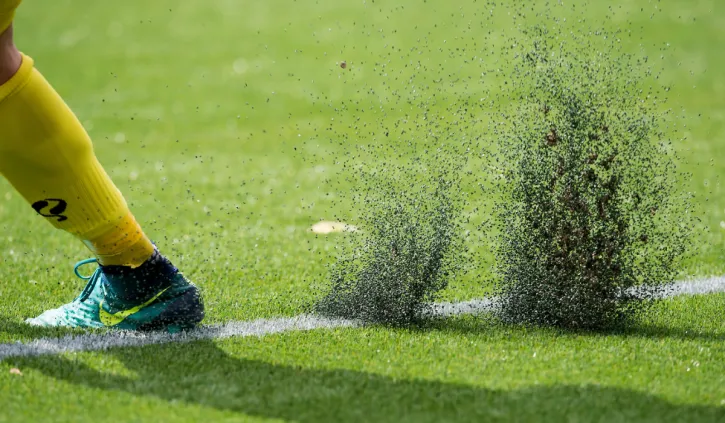
The artificial surface changes the dynamics of the game and challenges the tactical identity of the teams.
Clubs that cultivate technical football, with elaborate passing exchanges, may encounter difficulties on synthetic pitches.
On the other hand, teams that prioritize verticality, like Red Bull Bragantino, can exploit the surface to accelerate transitions.
An illustrative case occurred in 2024, when Cuiabá faced Always Ready in Bolivia.
The Brazilian team, accustomed to natural pitches, opted for a more direct game.
He used long throws to avoid controlling the ball in midfield.
The strategy resulted in a 1-1 draw, demonstrating how adapting to the terrain can level the playing field.
Additionally, analyzing team performance on different surfaces can provide valuable insights.
++ What is Race Walking and What are its Strict Rules?
The Players' Perspective
Athletes feel the impact of synthetic turf on their individual performance.
The faster ball demands sharp reflexes, especially for goalkeepers, who face more powerful shots.
Additionally, the surface can alter the way players perform fundamentals, such as ball control.
An original example would be the fictional midfielder João Ferreira, who adjusted his playing style on artificial pitches.
He prioritized low passes and avoided long-range shots, which tend to be more powerful.
Players also report that the heat generated by synthetic pitches can affect performance.
Surface temperatures can exceed 50°C, requiring constant hydration and energy management strategies.
However, clubs that frequently play on artificial turf invest in specific preparations.

The Future of Synthetic Turf
As technology advances, synthetic turf is becoming more sophisticated.
The fibers better mimic natural grass and cushioning systems reduce physical impact.
THE FIFA and the UEFA invest in stricter regulations to ensure that these fields meet quality standards.
In Brazil, clubs like Athletico Paranaense are pioneers in adopting this technology.
However, cultural resistance remains, as many players and fans prefer natural grass.
Could the future of the sport be embracing the consistency of the artificial?
The answer may depend on how teams adapt to this evolution.
Conclusion
Synthetic turf is more than a surface: it is an element that redefines football.
It speeds up the game, challenges precision and demands adaptations that test the versatility of teams.
However, with examples like Spartak Moscow and Cuiabá, we see that familiarity with the terrain can be a competitive advantage.
As technology evolves, the impact of synthetic turf on the style of play is likely to grow.
Therefore, the discussion about the effectiveness and implications of using synthetic turf continues to be a relevant topic among players and fans.