


Success in team sports is a reflection of the synergy between the individuals that make up the team.
Advertisements
THE teamwork in team sports is essential to achieve consistent results, having the power to transform a group of players into a well-synchronized machine.
In sports such as football, basketball, volleyball, handball and rugby, the ability to collaborate and understand each other can determine success or failure.
When we look at great teams and their historic victories, it becomes clear that individual talent alone is rarely enough.
A team's true potential is only revealed when each member understands their role and collaborates for the common good.
Advertisements
Therefore, in this text, we will explore the multiple facets of teamwork, its psychological importance, the benefits for sports performance, as well as strategies to strengthen these bonds between athletes.
What is teamwork in team sports?
THE teamwork in team sports refers to cooperation, communication and coordination between players with the aim of achieving a common goal: victory.
While this may seem obvious, executing this dynamic is complex and involves more than just technical skills.
Advertisements
For a team to function well, its members need to understand their own roles and how these fit into the strategic plan.
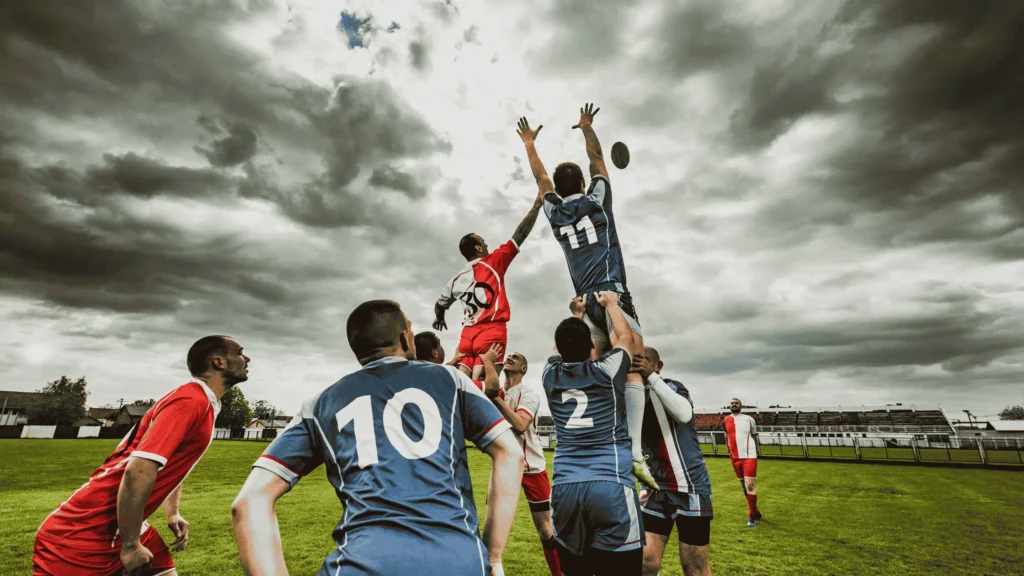
It is important that each player's role is clearly defined and that there is an open communication structure.
The ability to listen, adjust and, above all, trust others is essential.
In sports like soccer, for example, players need to align tactically and often sacrifice their own opportunities to benefit the team as a whole.
Furthermore, teamwork involves a constant process of feedback and adjustments.
Players need to learn to acknowledge mistakes constructively and celebrate collective achievements.
This continuous process of self-assessment and improvement is only possible when there is a sense of belonging and commitment to the group.
+ How to set up a workout routine for beginners
Psychological benefits of teamwork in team sports
Sports psychology investigates the importance of teamwork in team sports and its impact on players' mentality.
According to studies published by International Journal of Sports Psychology, Teams that have greater cohesion among athletes tend to have lower stress levels and greater resilience in pressure situations.
One of the main benefits of teamwork is the creation of a sense of psychological safety.
When athletes feel supported by their peers, they are more willing to take risks, innovate, and perform at their best.
This creates an environment where everyone tries their best, knowing that if they fail, they have the support they need to try again.
Mutual support also strengthens players' intrinsic motivation. A study by sports psychologist Albert Carron showed that collective motivation can increase by up to 30% in highly cohesive teams.
This is one of the reasons why integrating new players into a team is a crucial step for long-term success.
Teams with a well-established collective mentality also have greater longevity and stability, which is a differentiator in high-level competitions.
How teamwork in team sports increases performance
In the context of sports performance, the teamwork in team sports stands out as a determining factor for victory.
Effective collaboration improves the distribution of responsibilities, optimizes decision-making, and allows for faster adaptation to changing circumstances.
In other words, this occurs because a cohesive team can act as a single entity, where players trust in their respective abilities and the team's overall strategy.

Studies indicate that the performance of well-trained teams can be 20% to 30% superior in competitions.
According to a survey by Journal of Applied Sport Psychology, teams that invest in training focused on communication and cooperation obtain better results compared to those that focus only on technical aspects.
The ability to read the game, predict opponents' actions, and adjust tactics in real time depends on a strong bond between players.
Another relevant point is the way in which teamwork minimizes errors.
In high-performance sports, details can make the difference between victory and defeat.
When there is mutual trust, each player feels responsible not only for their own performance, but for the success of the group.
This action helps create a culture of collective accountability, where mistakes are corrected quickly and strategies are adjusted as needed.
| Factor | Impact on Performance |
|---|---|
| Efficient communication | Improved team coordination |
| Mutual trust | Reducing errors at critical moments |
| Distribution of functions | Maximizing individual skills |
| Integration activities | Increased team cohesion and motivation |
What is the relationship between teamwork and leadership?
An often overlooked aspect of teamwork in team sports is the role of leadership.
A good leader, whether coach or captain, needs to foster an environment where each player feels valued and encouraged to contribute to the team.
Therefore, these initiatives must involve clear communication, constant motivation and the development of a culture of mutual support.
Effective leaders in team sports are those who can balance individual demands with the needs of the group.
A study conducted by Harvard Business Review concluded that sports leaders who prioritize building interpersonal relationships are more successful in creating cohesive and resilient teams.

To promote the teamwork in team sports, it is crucial that the leader understands the psychological dynamics of the group and is able to intervene positively to strengthen these bonds.
It's interesting to note how some historic captains in sports, like Michael Jordan in basketball or Carles Puyol in football, had this innate ability to unite their teams around a common goal.
These leaders were not only technically superior, but they also had a deep understanding of what the team needed at critical moments, whether it was providing emotional support or adjusting strategies.
+ Case Studies: Athletes Who Successfully Changed Sports
Historical examples of successful teamwork
Throughout history, countless examples highlight the importance of teamwork in team sports.
One of the most iconic cases is that of the Chicago Bulls in the 90s, led by Michael Jordan.
Although Jordan was a star, he only achieved success when he realized he needed to rely on his teammates.
It was this transition to a more collaborative style that allowed the Bulls to win six NBA championships.
Another notable example is the New Zealand rugby team, the All Blacks.
Known for their cohesion and impeccable game strategy, the All Blacks are the most successful team in rugby history, and their success is directly attributed to teamwork.
In the documentary All or Nothing, the players reveal that the basis of their victory is the mutual respect and trust they have in each other.
In football, the Spanish national football team, winners of the 2010 World Cup, is another example of how cohesion can trump individual talent.
The “tiki-taka” style of play, based on possession and short passes, was only possible thanks to the synergy between players like Xavi, Iniesta and Busquets.
Each player knew exactly where the other would be, and the team functioned as a single unit, with complete confidence in the game strategy.
How to improve teamwork in team sports
The construction of a good teamwork in team sports It does not happen automatically; it requires investment, both in time and in personal and collective development efforts.
One of the most effective ways to strengthen these bonds is through training focused on cooperation and communication, of course.
Instead of prioritizing only technical skills, coaches should incorporate team-building exercises and foster an environment of constant feedback.
Furthermore, trust between team members must be cultivated both inside and outside the competition environment.
Research carried out by Journal of Sport Behavior indicate that teams that spend more time together off the field tend to have greater cohesion.
Activities such as informal meetings, group dynamics, and even fun games can strengthen these bonds.
Finally, a growth mindset and adaptability are crucial aspects of maintaining a cohesive team.
Players who adopt a continuous improvement approach, recognizing their strengths and weaknesses, tend to be more receptive to working as a team and adjusting their strategies for the benefit of the group.
Conclusion
THE teamwork in team sports is an essential part of success in any sport.
Indeed, effective collaboration, clear communication, and mutual trust create an environment where each player can perform at their best, knowing their teammates will support them.
As Bruce Ogilvie said, “The true measure of a team is its ability to connect emotionally and pursue a common goal.”
Therefore, strengthening these skills should not be underestimated, as it is a crucial differentiator for any team seeking victory.