
THE Footwork for playmakers This is probably the aspect of technical development in basketball that has lost the most ground in modern training programs — replaced by an obsession with dribbling, volume of three-point shots, and physical development, as if the feet were merely a means of transportation for a player whose true existence lies in the torso and hands.
Advertisements
The irony is that the point guards who most consistently excel in crucial moments in the NBA and European leagues — Shai Gilgeous-Alexander, Tyrese Haliburton, Jalen Brunson — share a characteristic that doesn't appear in the statistics but is visible to any attentive observer: a mastery of footwork that makes them efficient in situations where players with superior physical attributes stand still.
Footwork isn't just the mechanics of stopping after receiving the ball—it's the complete set of skills that determine how a point guard moves without the ball, how they create space before receiving it, how they transition between dribbling and shooting, and how they finish in the paint against larger defenders without relying on speed to create separation.
The Brazilian National Basketball League documents that versatility is one of the most valued attributes in modern basketball, but emphasizes that "no matter how much basketball evolves, there's no way to do without good point guards on the court"—and good point guards, in any system, start with what their feet do.
Modern basketball, dominated by efficiency analyses and three-point percentages, has created a generation of young point guards with sophisticated handles and honed shooting mechanics who arrive at practice without knowing how to execute a pivot correctly, without understanding the jump stop, and without ever having practiced the euro step as an isolated technical fundamental before attempting to use it in a game situation.
Advertisements
This article revisits the fundamentals of footwork that are being neglected and explains why they still are — and always will be — the foundation upon which all other point guard skills are built.
The Triple Threat Position: The Starting Point of Everything
The triple threat position is the fundamental footwork that most young point guards execute incorrectly—and which has the most tactical consequences when misunderstood, because it is literally the starting point of every offensive action after receiving the ball.
The triple threat means that the player, with the ball protected at their side and knees slightly bent, has three options simultaneously available for the defender to worry about: shooting, passing, or dribbling — and the quality of this position determines which of these options the defender will prioritize, which in turn defines which one the playmaker will use.
Advertisements
The most common mistake among young point guards is receiving the ball in an upright position or with their weight poorly distributed, which immediately eliminates the threat of penetration and transforms the triple threat into a double or single threat that experienced defenders instantly read and adjust their position to neutralize.
Proper practice begins with the most basic exercise possible: receiving the ball from a partner, assuming the triple threat position immediately upon receiving it, maintaining it for three seconds identifying which of the three options would be most available in that position, and repeating this cycle dozens of times before any dynamic action is added.
The classic drill that accelerates this development is the "Triple Threat Stance to Two Explosive Dribbles"—the point guard starts from the triple-threat position behind a line, executes two explosive dribbles to the outside, and performs a controlled jump stop, 180-degree pivot, and strong pass to the next player in line—an exercise that combines posture, explosiveness, stopping, and pass-out in a sequence that replicates real game movements.
++ Training for Reaction and Decision Making Under Fatigue
The Jump Stop and the Pivot: The Two Most Neglected Fundamentals
The jump stop and the pivot are the most neglected footwork fundamentals in the development of young point guards—and the ones with the most practical consequences when absent, because every finish in the paint, every change of direction after a dribble, and every creation of space for a shot depend on one of these two actions being executed correctly.
The jump stop is a stop where the player lands with both feet simultaneously, keeping the pivot foot undecided until a decision is made — which is technically different and more advantageous than the one-foot-follow-the-other stop, which fixes the pivot foot at the moment of the first landing and reduces the available options.
In practice, the difference may seem small but it's crucial: a point guard who stops with both feet simultaneously can pivot in any direction before shooting, passing, or restarting the dribble — one with an asymmetrical stop has already fixed the pivot and reduced their options in a way that experienced defenders identify and exploit immediately.
The pivot itself — the rotation of the body around the fixed foot — is the fundamental footwork that Steve Nash, Tony Parker, and Chris Paul used to create separation in the paint without relying on physical superiority or speed over the defender, and which Brazilian point guards rarely practice in isolation enough to develop it to the level of automaticity that the game demands.
| Foundation | Most common mistake | Correction | Recommended drill bit |
|---|---|---|---|
| Triple threat | Upright position when receiving | Knees bent, ball to hip. | Triple threat + 2 dribbles + jump stop |
| Jump stop | Asymmetrical stop | Simultaneous landing of both feet | Dribbling + jump stop + 180° pivot + pass |
| Offensive pivot | Pivot foot raised before the pass. | Maintain constant contact with the ground. | Pivot drill without ball + with ball |
| Euro step | Unsteady steps, lack of balance. | Consciously counting the two steps | Isolated cone drill without defender. |
| Cut without ball | Walking instead of cutting | Explosive change of speed | V-cut and L-cut with the ball received |
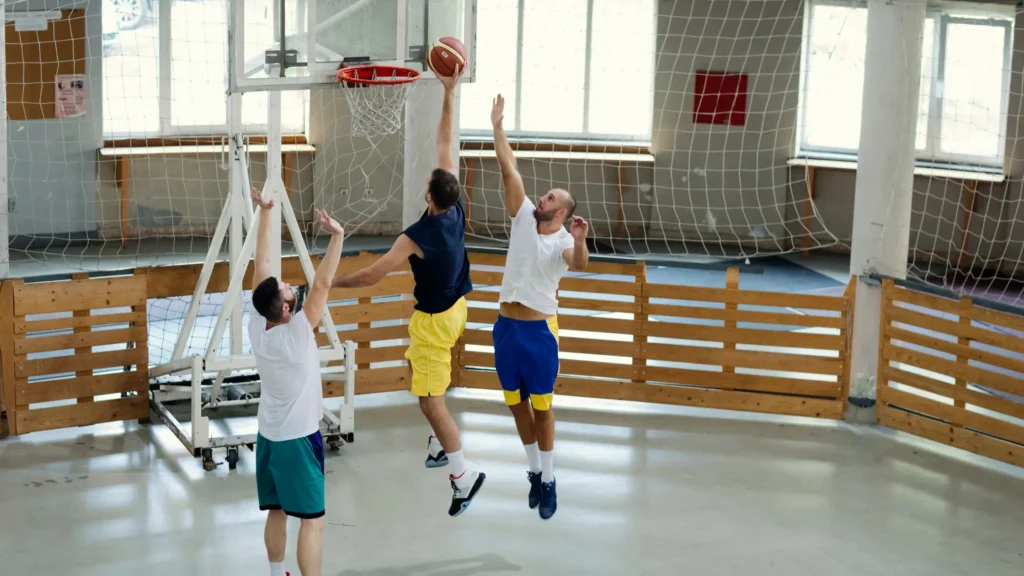
Off-the-ball movement: The footwork that determines whether you get the pass.
Off-the-ball footwork is the aspect of point guard development that most clearly separates players who understand the game from those who only have skill with the ball in their hands — and it is consistently the most ignored in individual training sessions where 90% of the time is dedicated to dribbling and shooting with the ball always in possession.
The V-cut and the L-cut are the two most important off-ball movement fundamentals for point guards because they define how the player creates passing lanes to receive the ball in advantageous positions within the offensive system—and because, when executed incorrectly, they render any offensive scheme ineffective regardless of the playbook's quality.
The V-cut begins with the point guard feigning a movement in one direction—taking two or three controlled steps that convince the defender that this is the destination—explosively changing direction and creating enough separation to receive the ball in the space created by the feint, which most young point guards execute with uniform speed rather than variable speed, eliminating the element of deception that gives the movement its usefulness.
The agility ladder is the most efficient tool for developing the footwork coordination needed to execute cutting movements with speed and precision — drills like “two-foot in, two-foot out” and sequential lateral jumps build the neuromuscular foundation that allows the point guard to execute explosive V-cuts and L-cuts without losing balance when receiving the ball in motion.
++ How to Train Your Mid-Range Shot
The Euro Step and the Floater: Finishing Footwork in the Paint
The euro step and the floater are the two finishing moves in the paint that most depend on precise footwork — and the two that young point guards most often execute technically incorrectly because they have never practiced them in isolation, as fundamentals, before trying to apply them in a game situation.
The euro step is legally two steps after the dribble is finished: the first step goes in one direction, the second goes in the opposite direction, creating separation from the defender by changing the angle before the shot — but most young players execute the movement with irregular steps that vary in size and pace with each attempt, making the mechanics inconsistent and the movement too slow to be effective against prepared defenders.
The correct practice begins without a defender and without the ball: the playmaker starts from a mark on the ground, consciously executes the first step, then the second step in the opposite direction, and simulates the shot — repeating dozens of times until the mechanics become automatic and can be executed at maximum speed without the need for conscious attention to counting the steps.
FIBA It establishes that the two-step rule applies regardless of how many steps the player takes before initiating legal steps, which means that understanding the exact moment when the dribble ends and the steps begin is a technical skill that point guards need to master in order to execute advanced finishing moves within the rules without committing steps that invalidate well-executed plays.
The floater — a short, high-trajectory shot that goes over taller screeners — depends on specific footwork and approach techniques that most point guards don't practice in isolation: the starting foot, the distance from the basket to finish, and the approach angle determine the floater's effectiveness much more than the mechanics of releasing the ball, which is the part that receives practically all the attention in training.
How to Structure a Footwork-Focused Training Program
An effective footwork drill for playmakers requires no more than 30 to 40 minutes, doesn't require partners, and produces measurable improvements in four to six weeks of consistent practice—making it an extremely worthwhile time investment for players at all developmental levels.
The most efficient structure divides the training into three blocks: an 8-10 minute coordination warm-up with agility ladder exercises, a 15-20 minute block of isolated fundamentals, and a 10-12 minute speed integration block, with progression of complexity within each block but never adding speed before the mechanics are consolidated at a controlled pace.
++ How to Use Agility Ladders Without Falling into the Monotony of Traditional Exercises
The isolated fundamentals block should dedicate approximately equal time to the four main fundamentals — triple threat and jump stop, offensive pivot, off-ball movement, and finishing in the paint — resisting the temptation to spend most of the time on the most recently practiced movement or the one that seems most advanced and attractive.
THE Brazilian Basketball Confederation It suggests that the technical development of young playmakers should be built upon solid fundamentals before the introduction of compound movements — a recommendation that applies to footwork the same principle that sports pedagogy establishes for any complex motor skill: the automation of the basics is what frees up cognitive attention for the tactical decisions that the game simultaneously demands.
Conclusion
Footwork drills for point guards represent a time investment that yields a disproportionately high return compared to what most young players imagine—not because footwork is more important than dribbling or shooting, but because it is the foundation upon which all other skills become consistent rather than situational.
Jalen Brunson, who led the New York Knicks to the 2026 NBA title with 45 points in the finals, isn't the most athletic point guard in the league—he's one of the best at using footwork to create advantages where faster players would create them with speed, and that efficiency is a product of fundamentals that were practiced in isolation before being integrated into the game.
The point guard who masters the triple threat, the jump stop, the offensive pivot, and off-ball movement doesn't need to be the fastest, tallest, or strongest on the court—he just needs to always be positioned one step ahead of the defender, and that starts with his feet before anything else.
FAQ
1. What is footwork in basketball and why is it important for point guards? Footwork is the set of skills that determines how a player moves with and without the ball — stops, pivots, cuts, and finishing movements. For playmakers, it's the foundation that determines efficiency in creative situations, because it allows them to create separation and positional advantages without relying exclusively on speed or physical explosiveness.
2. What is the most neglected footwork fundamental among young point guards? The offensive pivot and the jump stop are the most neglected. Most individual training sessions dedicate almost all the time to dribbling and shooting, ignoring the fact that the quality of the stop after the dribble determines which options are available—and that a correctly executed pivot can create the same separation that an explosive drive would require.
3. How much time per week should I dedicate specifically to footwork? Two to three weekly training sessions of 30 to 40 minutes are sufficient to produce measurable improvements in four to six weeks. Footwork can be practiced in isolation without partners or special equipment, making it one of the most accessible and efficient ways to invest in technical development.
4. How to practice the Euro Step correctly from scratch? Start without the ball and without a defender: start from a mark, take the first step in one direction, the second step in the opposite direction, and simulate a shot—repeating at a controlled speed until the mechanics become automatic. Only add the ball after the counting and footwork mechanics are consolidated without requiring conscious attention.
5. Does the agility ladder really help in developing footwork? Yes, especially to develop the neuromuscular coordination that allows you to execute cuts and changes of direction with precision and balance. Exercises like "two-foot in, two-foot out" and lateral jumps build the foundation that makes V-cut and L-cut movements without the ball explosive enough to create real separation against prepared defenders.