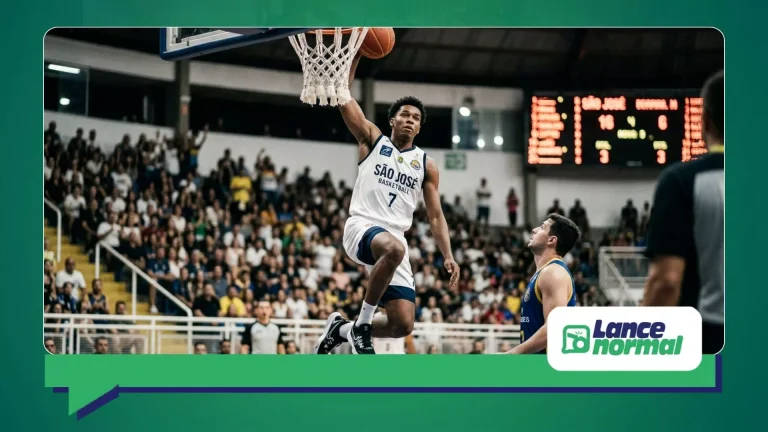


The rise of shooting guards It redefines the contemporary NBA, profoundly altering how teams build rosters, attack defenses, and distribute creative responsibilities on the court.
Advertisements
Over the past two decades, professional basketball has undergone accelerated tactical transformations, driven by data, spacing, and new readings of offensive efficiency at all levels of the game.
In this context, the number 3 position ceased to be merely complementary and began to concentrate functions previously restricted to playmakers and more physical wingers.
The convergence of creativity, scoring ability, and defensive versatility has transformed these athletes into central pieces for any competitive project.
More than a passing trend, the dominance of this position reflects structural changes in player development from the grassroots level.
Advertisements
This article analyzes how, why, and with what consequences shooting guards have become the protagonists of the modern NBA.
The historical evolution of the shooting guard position in the NBA.
For decades, the power forward position has been associated with specialists in perimeter defense and accurate shooting, acting as a link between the dominant inside game and the creation of classic point guards.
In the 1980s and 1990s, wings primarily needed to guard opposing stars and convert mid-range shots, while the offensive organization remained focused on traditional point guards.
Advertisements
The turnaround began slowly, as taller players started demonstrating above-average ball control and game vision capable of initiating attacks.
This transition gained momentum with rules that favored spacing, reducing defensive contact on the perimeter and encouraging infiltrations and quick passes.
With less reliance on fixed centers, teams began to explore wing players capable of reading moving defenses and punishing defensive switches.
Thus, the number 3 position ceased to be secondary and began to assume strategic responsibilities that shape the offensive identity of the franchises.
++ How college basketball shapes the stars of the future.
The impact of spacing and the three-point shot.
The rise in the volume of three-point shots has redefined the value of players capable of threatening defenses in multiple zones of the court.
Shooting guards have directly benefited from this scenario, as they combine height to finish near the rim with the reach to punish deep-lying perimeter defenses.
The statistical analysis promoted by teams and by itself NBA It reinforced the pursuit of efficiency, prioritizing shots with high expected value.
In this environment, hybrid players began to generate consistent advantages, forcing complex defensive adjustments with each possession.
The ability to create one's own shot after dribbling has become as valuable as accuracy in catch-and-shoot situations.
Consequently, position 3 came to concentrate players who maximize offensive return without compromising the collective defensive balance.

Defensive versatility as a competitive advantage
Beyond their offensive impact, shooting guards have become essential due to their ability to defend multiple positions with consistent efficiency.
With defensive switches becoming more frequent, teams need players capable of guarding fast point guards and stronger wings without collapsing the system.
This versatility reduces the need for constant adjustments and allows for more aggressive schemes, pressing passing lanes and contesting shots.
Studies published by institutions such as MIT Sloan Sports Analytics Conference They highlight the value of these athletes in advanced defensive metrics.
Players who combine tactical awareness and lateral mobility offer security in the final stages of the game, when every possession becomes crucial.
Thus, dominance in position 3 is not explained solely by points scored, but by the defensive stability that these athletes provide.
++ Sports nutrition: what really makes a difference in performance
Modern training and changing athlete profiles
The basketball youth system has begun to produce more well-rounded players, encouraging wing players to develop fundamentals traditionally associated with point guards.
In youth categories, tall athletes train dribbling, passing, and game reading from an early age, breaking old positional stereotypes.
This approach broadens the range of skills and prepares players for hybrid roles at the professional level.
As a result, the NBA gets shooting guards capable of leading the offense without sacrificing efficiency or emotional control.
Physical adaptation also accompanies this evolution, with training focused on mobility, functional strength, and endurance.
This new profile explains why position 3 has become a point of convergence between technical talent and advanced athletic preparation.
++ Post-game recovery: ice baths, cryotherapy, and cutting-edge methods.
Examples of shooting guards who redefined the league.
Some players symbolize this transformation, not just through statistics, but through the structural impact they have on their franchises.
Athletes like LeBron James have shown that a forward can lead offenses, dictate the pace, and even defend larger positions when necessary.
Others, like Kevin Durant, have elevated the concept of the versatile scorer, combining historical efficiency with high-volume playmaking.
These examples inspired subsequent generations to expand their technical ambitions beyond traditional roles.
The league has begun to value contracts and projects centered on these hybrid profiles, reflecting their strategic importance.
The consistent success of these stars has solidified the number 3 position as the central axis of contemporary basketball.
Tactical comparison between traditional and hybrid positions
The transformation of position 3 can be better understood by comparing old responsibilities with the current demands of the modern game.
The following table illustrates key differences between traditional wings and contemporary shooting guards in relevant tactical aspects.
| Appearance | Traditional Wing | Modern Point Guard |
Offensive role | Secondary finisher | Primary and secondary playmaker |
Ball control | Limited | Advanced
| Game reading | Situational | Constant |
| Defensive versatility | Medium | High |
Impact on finals | Complementary | Decisive |
This comparison highlights how tactical evolution has broadened the scope of action for position 3.
By taking on roles previously distributed among the players, shooting guards increase the offensive unpredictability and defensive cohesion of teams.
Consequences for the future of the NBA
The dominance of shooting guards directly influences draft, development, and roster building decisions.
Franchises prioritize players capable of adapting to multiple systems, reducing reliance on one-dimensional specialists.
This trend also affects the market, increasing the value of contracts for athletes who deliver impact across multiple fronts.
In the long term, the league tends to become even more fluid, with increasingly less rigid positions.
In this scenario, position 3 serves as a model for the evolution of the other positions on the court.
Therefore, understanding this transformation is essential to understanding the strategic direction of the NBA.
Conclusion
The rise of shooting guards represents a structural change in professional basketball, reflecting profound tactical, technological, and formative adaptations.
More than just a trend, this evolution responds to the demands for efficiency, versatility, and game reading imposed by the current pace of the NBA.
By focusing on creation, scoring, and defense, position 3 became the point of balance between attack and containment.
Understanding this phenomenon helps explain why modern rosters gravitate towards these hybrid athletes.
FAQ
1. What defines a shooting guard in today's NBA?
A shooting guard combines the stature of a wing player with the skills of a point guard, including ball handling, offensive playmaking, and constant tactical awareness under pressure.
2. Why has position 3 gained so much importance recently?
The evolution of spacing, efficiency metrics, and defensive switching has favored versatile players capable of impacting multiple areas of the game simultaneously.
3. Do shooting guards replace traditional point guards?
They don't completely replace each other, but they share creative responsibilities, making attacks less predictable and harder to neutralize.
4. Does this trend affect basketball outside of the NBA?
Yes, international leagues and youth academies replicate this model, producing more well-rounded players who are less tied to fixed positions.
5. Should the dominance of shooting guards continue?
Everything indicates that this is the case, as the game continues to value versatility, decision-making, and bilateral impact on the court.